



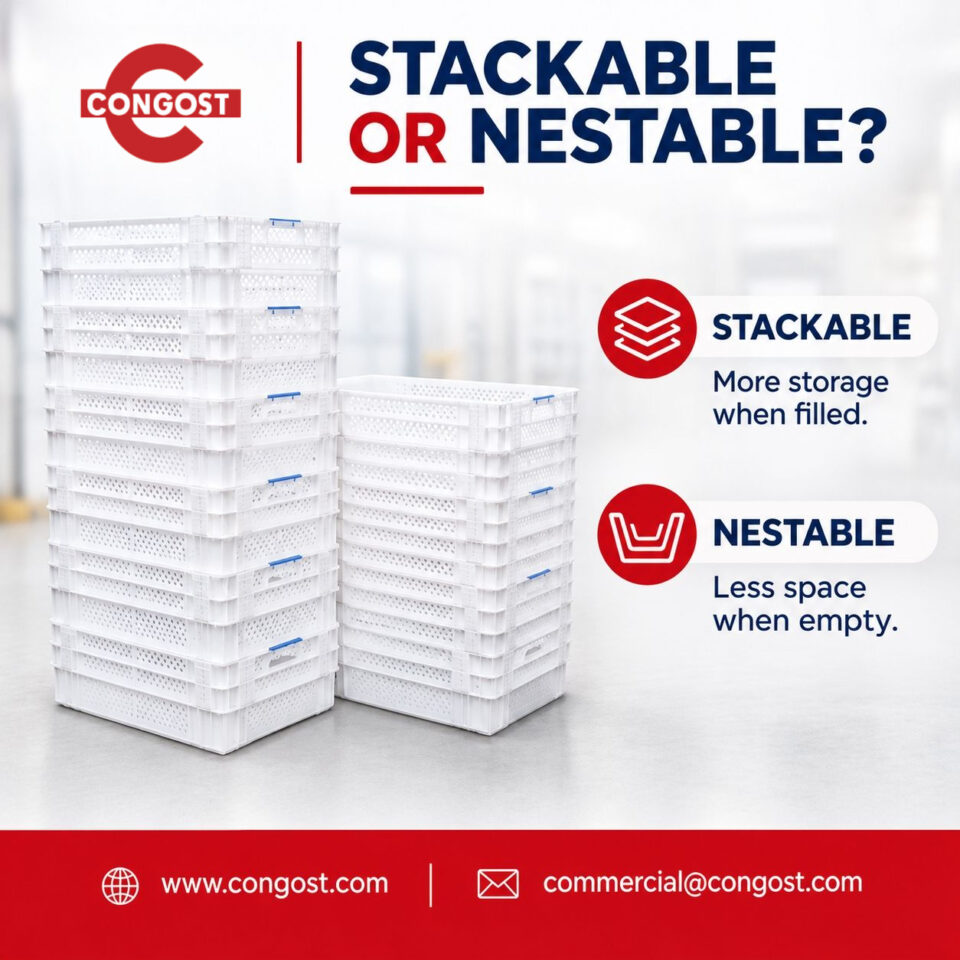
Not all plastic containers are designed in the same way. Depending on their design and intended use, they can offer different advantages for storage, handling and transport.
Two common solutions in industrial logistics are stackable and nestable containers. Although they may look similar, their designs serve different purposes.
Stackable containers: maximise storage when filled
Stackable containers are designed to be placed securely on top of one another when loaded or in use.
Their structure allows businesses to make better use of available vertical space, helping to optimise storage areas, production facilities and warehouse operations.
They are particularly useful when containers need to remain stacked during handling, storage or internal logistics processes.
Nestable containers: save space when empty
Nestable containers are designed to fit inside one another when empty.
This feature significantly reduces the space required for storing unused containers and makes return transport more efficient.
By reducing the volume occupied by empty containers, businesses can optimise warehouse space and improve logistics operations.
Choosing the right solution for your business
The choice between stackable and nestable containers depends on the specific requirements of each application.
While stackable containers help maximise storage capacity when filled, nestable containers offer important space-saving advantages when empty.
At Congost Plastic, we offer practical plastic container solutions designed to meet different handling, storage and logistics requirements across a wide range of industries.
Choosing the right container design can make a difference in improving operational efficiency and optimising available space.
Looking for the right plastic container solution for your business?
Discover our range of plastic containers at www.congost.com or contact our team at commercial@congost.com.
Siguenos


Comparte


